
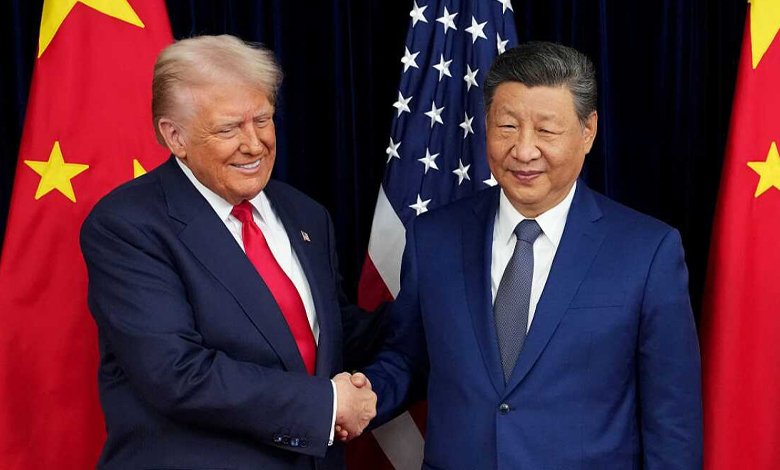
In a significant diplomatic development, US President Donald Trump announced a series of major trade breakthroughs following his meeting with Chinese President Xi Jinping in Busan, South Korea. The high-stakes discussion, their first in six years, marks a turning point in US-China relations, easing trade tensions and restoring cooperation on multiple fronts.
Trump confirmed that he had agreed to cut fentanyl-related tariffs on China to 10 percent, effective immediately. The overall tariffs on Chinese goods have also been reduced from 57 percent to 47 percent, a move aimed at strengthening bilateral trade and encouraging Beijing’s cooperation on the fentanyl crisis.
“I expect to be lowering that because I believe that they’re going to help us with the fentanyl situation,” Trump said aboard Air Force One. “The relationship with China is very good,” he added, describing Xi as “a tremendous leader of a very powerful country.”
The agreement comes after months of volatility in tariff rates, with Washington earlier threatening steep hikes on Chinese imports amid disputes over rare earth exports and fentanyl trafficking. Trump’s latest move signals a strategic recalibration, driven by global economic concerns and domestic political optics ahead of the next election.
Soybean Trade Resumes Amid New Commitments
One of the most notable takeaways from the Trump-Xi meeting was China’s commitment to resume large-scale soybean purchases from the United States. Trump said that Beijing would begin immediate imports of US soybeans, although specific volumes were not disclosed.
According to trade sources, China’s state-owned COFCO has already bought three shipments from this year’s US harvest — a gesture widely interpreted as a goodwill signal to rebuild agricultural trade ties disrupted during the trade war.
Rare Earth Deal Brings Relief to US Tech Industry
Another critical outcome was the rare-earth export agreement, which Trump described as “settled.” China, the world’s leading producer of rare earth minerals essential for defense and high-tech manufacturing, agreed to maintain its supply flow for at least one year, with an option to extend the deal.
The agreement is expected to stabilize global supply chains for industries reliant on rare earths — from electric vehicles and robotics to fighter jets and semiconductor technologies. Trump emphasized that resolving the rare-earth issue was vital to the interests of both nations.
Joint Efforts on Ukraine and Global Security
The two leaders also discussed the ongoing Ukraine conflict, agreeing to “work together” toward a peaceful resolution. Trump revealed that Xi Jinping expressed willingness to assist in diplomatic efforts to end the war, marking a rare moment of cooperation between the two global powers on a critical international issue.
“Ukraine came up very strongly. We’re both going to work together to see if we can get something,” Trump said. “Sometimes, you have to let them fight, I guess — not a lot we can do.”
Trump to Visit China in April for Follow-Up Talks
Concluding the meeting, Trump announced his plans to visit China in April for follow-up discussions, while Xi Jinping is expected to make a reciprocal visit to the United States later next year.
“I’ll be going to China in April, and he’ll be coming here sometime after that,” Trump said, indicating that both sides had agreed to “finalize a lot of things” during their next engagement.
The Busan meeting marks the most constructive phase in US-China diplomacy since the 2018 trade war, signaling renewed cooperation in global trade, technology access, and security. As Trump put it, “This was a great success — a very positive step for both our nations.”