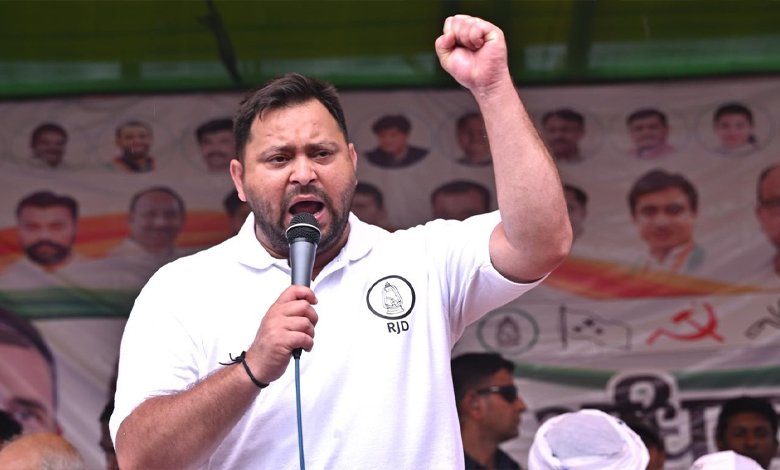
The rise of Tejashwi Yadav is no longer just a political talking point — it’s a developing reality reshaping Bihar’s political balance. Once dismissed as a political novice and a product of dynasty politics, Tejashwi has steadily grown into one of the most influential opposition leaders in India’s Hindi heartland. With the Bihar Election 2025 looming, his role could be decisive in determining the future of the state’s governance and leadership narrative.
Born into the powerful Yadav political family, Tejashwi Yadav inherited not only his father Lalu Prasad Yadav’s party, the Rashtriya Janata Dal (RJD), but also the burden of rebuilding its credibility in a rapidly changing Bihar. Over the years, he has evolved from a reluctant politician to a confident strategist, often seen bridging generational gaps within the RJD while appealing to Bihar’s youth and lower-income voters.
What makes Tejashwi Yadav’s rise in Bihar politics so compelling is his ability to connect with the aspirations of a new voter base — one that demands jobs, dignity, and development, beyond the traditional caste arithmetic. His campaign focus on “Rozgar” (employment) has struck a deep chord, especially among young Biharis frustrated with migration and lack of local opportunities.
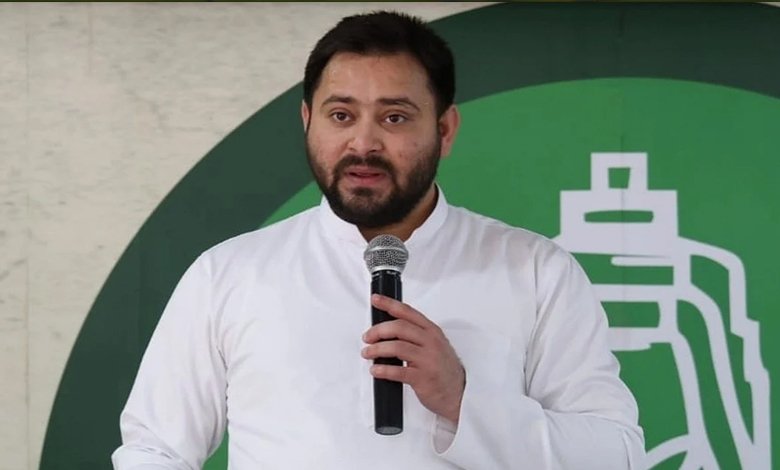
In 2020, when the Bihar Assembly Election results came out, the RJD under Tejashwi’s leadership emerged as the single largest party — a remarkable achievement that signaled the beginning of a generational shift. While he fell short of forming the government, the momentum from that election continues to define his political strategy heading into 2025.
Tejashwi’s critics often point to his inexperience and dependence on his father’s legacy. But over time, he has carved out a distinctive identity. Unlike many in the current political spectrum, Tejashwi avoids communal rhetoric, focusing instead on governance and economic issues. His speeches are laced with youthful confidence and a pragmatic tone — an approach that appeals to Bihar’s expanding urban electorate.
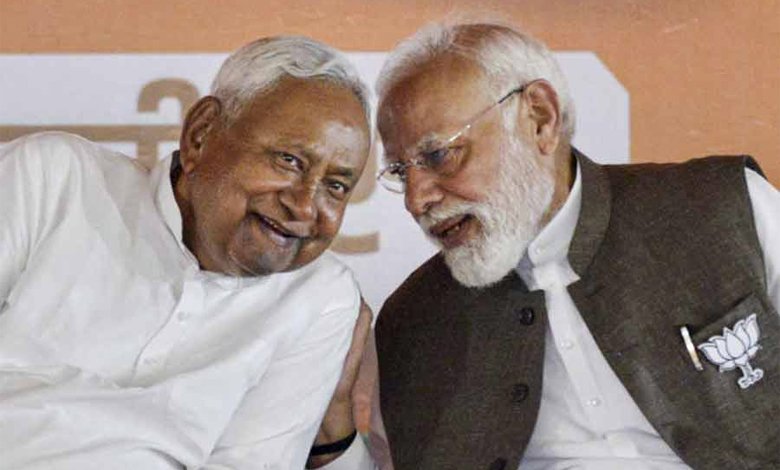
The Bihar political landscape has long been dominated by veteran leaders like Nitish Kumar and Lalu Prasad Yadav, whose decades-old rivalry defined the state’s governance model. But now, as Nitish faces anti-incumbency and a fragmented alliance system, Tejashwi Yadav’s emergence offers an alternative — a blend of legacy and modern leadership.
Observers note that the Bihar 2025 election could mark a turning point. The RJD’s growing alliances, especially its coordination with Congress and Left parties, could present a formidable challenge to the BJP-JDU combine. The question remains: can Tejashwi convert his popular appeal into concrete votes across caste lines?
Beyond Bihar, Tejashwi’s political image is also expanding nationally. In the INDIA bloc’s meetings, he is increasingly viewed as one of the young faces of opposition unity, representing the generational transition that India’s regional politics has been waiting for. His ability to balance ideological conviction with coalition pragmatism makes him a key player in shaping national narratives as well.
As Bihar prepares for another electoral battle, one thing is certain — Tejashwi Yadav is no longer in his father’s shadow. His leadership, strategy, and resilience are defining a new era. Whether he can truly rewrite Bihar’s political story will depend on how convincingly he transforms public sentiment into political mandate.