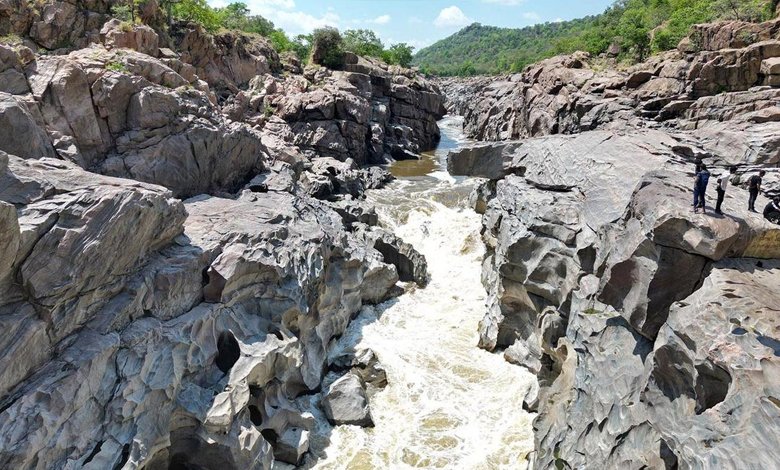
The Supreme Court on Thursday described Tamil Nadu’s plea against the proposed Mekedatu reservoir project as “premature,” refusing to block the expert bodies examining the project from continuing their review. The Court emphasised that Karnataka’s Detailed Project Report (DPR) is still under technical scrutiny and has not received any formal approval.
A Bench led by Chief Justice of India B.R. Gavai said the Mekedatu reservoir project is presently being evaluated by the Cauvery Water Management Authority (CWMA) and the Cauvery Water Regulation Committee (CWRC). The Central Water Commission (CWC) has already clarified that the DPR will not be accepted without clearances from both panels.
The Court noted that if the DPR is approved in the future, “all affected parties, including Tamil Nadu, are free to act in accordance with the law.”
Crucially, the Bench assured that Karnataka remains bound by the Supreme Court’s earlier orders mandating release of Cauvery water to lower riparian Tamil Nadu and Puducherry. The Mekedatu reservoir project, the Court said, cannot override that obligation under any circumstances.
The hearing stemmed from Tamil Nadu’s application seeking a direction to restrain the CWMA from deliberating the reservoir proposal. The State said the Mekedatu reservoir project, with a proposed capacity of 67.16 TMC ft and 400 MW power generation, violates the Cauvery Water Disputes Tribunal’s 2007 award and the Supreme Court’s own 2018 judgment.
Tamil Nadu, represented by senior advocate Mukul Rohatgi, argued that the Tribunal’s final decision protects downstream irrigation requirements, and that impounding water through the Mekedatu reservoir project could jeopardise the guaranteed supply at Billigundlu.
Karnataka, represented by senior advocate Shyam Divan, called Tamil Nadu’s fears “completely misconceived.” He maintained that the Mekedatu reservoir project would not affect the water allocated to Tamil Nadu and characterised the application as speculative.
Tamil Nadu, however, argued that the proposed reservoir would significantly alter natural flows from multiple sub-basins. It said the Mekedatu reservoir project could impound water from the uncontrolled catchment of the Kabini sub-basin, Cauvery flows below the KRS dam, and streams such as Shimsha, Arkavathy and Suvarnavathy—all crucial for ensuring 177.25 TMC at Billigundlu as mandated by the Tribunal.
The State further claimed that CWMA has no authority to deliberate on the project while Supreme Court proceedings regarding the DPR are still pending. Tamil Nadu has sought directions for the CWC to return the DPR and for the Environment Ministry to refrain from processing any clearance requests related to the Mekedatu reservoir project.
The Court did not accept Tamil Nadu’s contention at this stage. The Bench observed that until expert committees complete their assessment, any judicial intervention would be premature. It reiterated that the project remains a proposal unless approved by statutory bodies.
The Mekedatu reservoir project has long been a flashpoint between the two southern states. Karnataka argues that the reservoir is essential for Bengaluru’s drinking water needs, while Tamil Nadu views it as a threat to its court-mandated share of Cauvery water. With the Supreme Court’s latest remarks, the immediate legal battle may have paused—but the larger political and inter-state tensions surrounding the project remain very much alive.
For now, Karnataka awaits expert clearance, Tamil Nadu prepares for the next legal step, and the Mekedatu reservoir project continues to sit at the centre of a decades-long dispute over the Cauvery’s fragile water balance.